
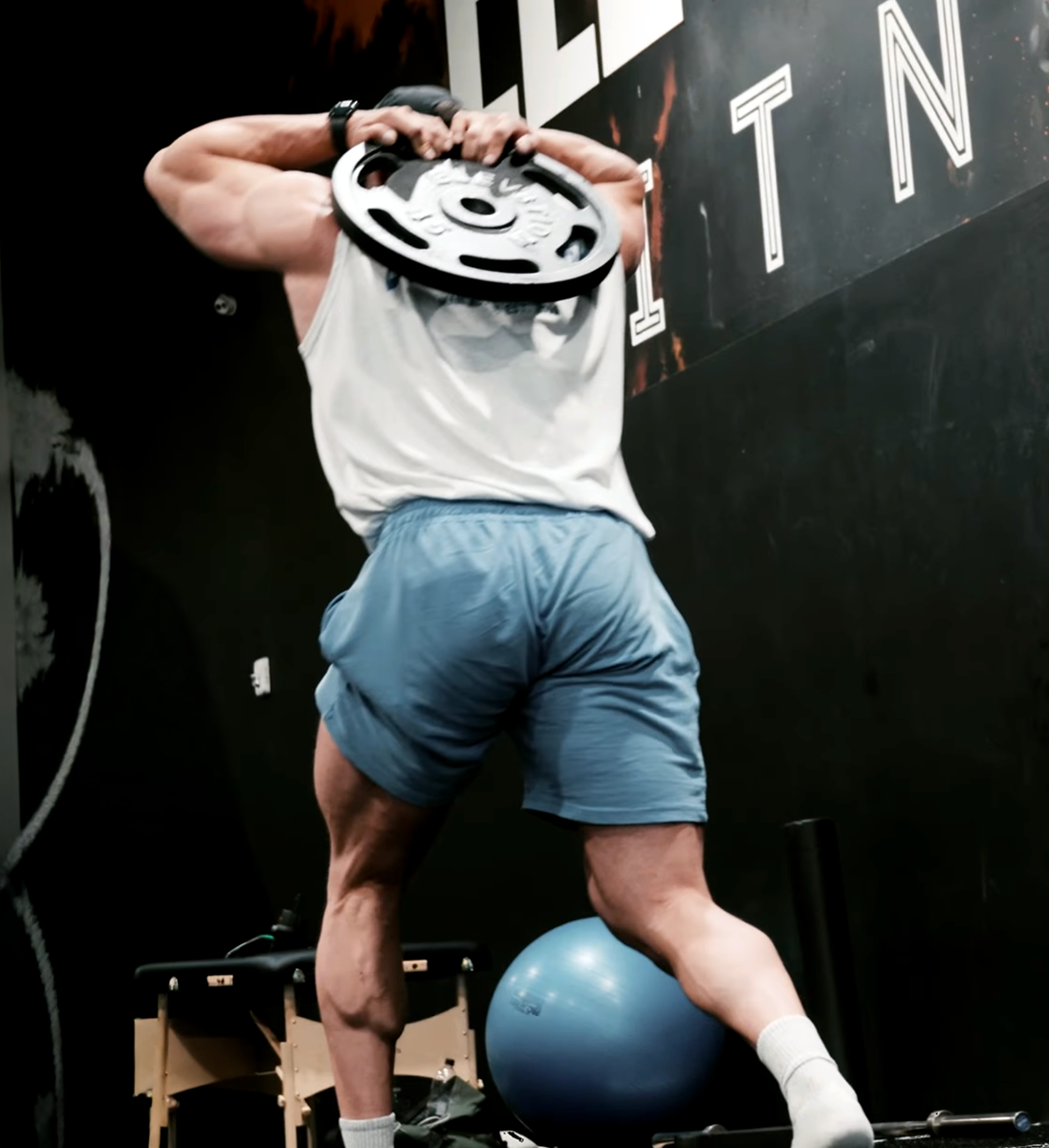
Most people load lunges one of two ways: dumbbells hanging at their sides, or a barbell across their back. Both work — but when I’m trying to sculpt my legs instead of just survive a set, I often use a third option that looks almost too simple to matter.
Here’s my trick.
I’ll take a weight plate, place it behind my head, and rest it across my upper traps — almost like a high, compact back-load. The moment you try it, you feel the difference: your posture changes, and your core locks in.
The first reason I love this variation is that it forces clean mechanics. With dumbbells, it’s easy to drift forward without noticing — your torso tips, your hips shift, and suddenly your “leg exercise” becomes a lower-back balancing act. With a plate loaded high, that forward lean gets exposed immediately. Your chest naturally stays tall, your spine stays aligned, and the tension lands exactly where you want it: quads, glutes, and stabilizers — not your back.

It also creates a more balanced load. Dumbbells can pull you side-to-side, especially when fatigue hits. A barbell can be effective, but it can also feel overly technical for a movement that should stay smooth and controlled. The plate sits in a sweet spot: centralized and stable, but not so rigid that it changes the natural mechanics of the lunge. You can move with more rhythm — and that matters when you’re chasing quality reps.
And then there’s the core. The moment the plate goes behind your head, your midsection instantly turns on. Your torso has to stay stacked. Your hips have to stay controlled. Your descent becomes cleaner. That’s one of the reasons I like this during sculpting phases: it builds shape and stability at the same time.
This setup also makes unilateral work even more honest. Lunges already expose imbalances, but with the load high and centered, you can’t hide behind momentum or awkward compensations. If one leg is weaker, you’ll feel it immediately. That’s a good thing. It’s how you find weak links and fix symmetry issues in the quads and glutes before they become habits.

Finally, because the load is stable and your posture is locked in, you naturally slow down. You take a deeper step. You control the bottom. You own the rep. That’s where the “sculpting” effect really comes from: time under tension, clean mechanics, and reps that don’t leak energy in ten different directions.
If you try this, start light and treat it like a form drill. It might feel a little awkward at first, so you definitely want to get comfortable with the motion before moving to a heavier weight. Stay tall, stay controlled, and let every rep be smooth and strict. Once you get the hang of it, you’ll understand why I keep it in my toolbox: it’s one of the simplest ways to make lunges feel more like precision work than punishment.
Strong legs aren’t built with ego. They’re built with smart choices — and this is one of mine.