
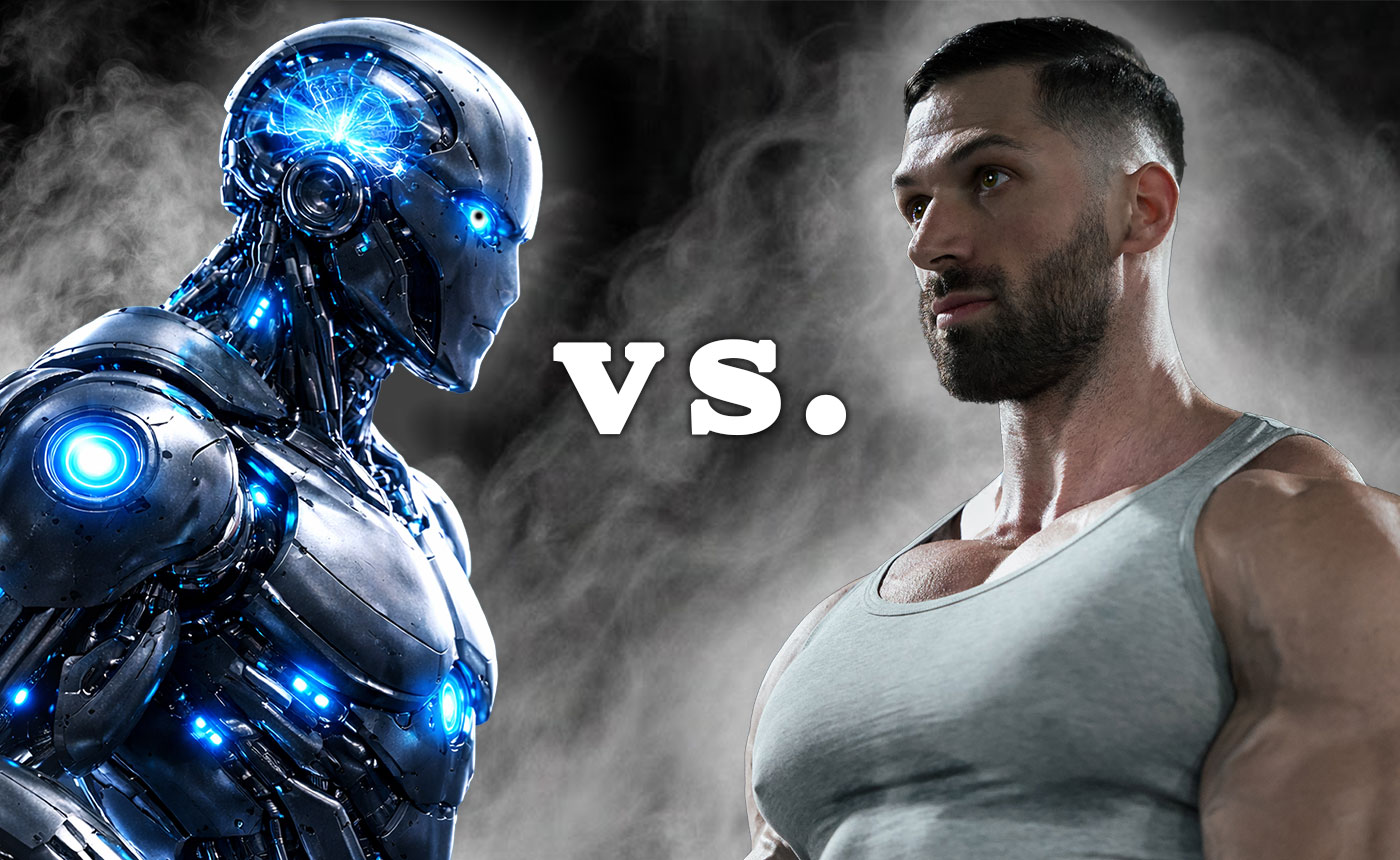
AI can write you a “perfect” training plan in seconds.
It can spit out macros, map out a weekly split, recommend exercises, and even tell you what to eat when you’re stuck in an airport with nothing but bad options. On paper, it looks clean. Intelligent. Professional.
And that leads to an interesting question: if AI can build the program, what’s left for a human coach to do? Have human fitness coaches and personal trainers become obsolete? Irrelevant? Relegated to the dustbin of history?
I’d argue no, and here’s why.
An AI system like ChatGPT or Gemini can spit out a training plan for you, but most people don’t fail because they lack a plan.
They fail because they don’t know how to run the plan — how to execute it with the right intent, how to adjust it when their body gives different feedback than expected, and how to stay consistent when sleep is short, stress is high, and life starts pushing back. That’s where the real coaching begins.

I’ve coached many different types of clients over the years, from complete beginners to athletes who were already training seriously. I’ve also lived this life as a professional competitor, where small decisions aren’t just “nice to have” — they show up on stage. So when people ask me, “Can AI coach me?” my answer is always the same:
AI can help you… but you need to understand what it can’t do.
If you use it correctly, it can make your training smarter, more efficient, and more consistent. If you use it blindly, it can waste months of your time — or even get you injured.
Let’s explore this in more depth.
What AI Is Actually Good For (And Why It’s Useful)
Now you might be thinking, “OK, Alessandro. You’re a human and you’re also a fitness coach. So you’re biased — of course you’re going to say that AI has no place in training.”
But, I do think AI has a very important place in training. The strongest use of AI in fitness is simple: it’s great at providing information.
If you’re new to training, AI can help you understand the basics faster than most people ever do. You can ask it questions you’d be embarrassed to ask in the gym. You can learn how exercises work, what muscles you should feel, how volume and intensity work, and how nutrition affects performance.
That matters, because most people are walking around with huge gaps in knowledge. They train randomly, they eat randomly, and then they wonder why progress feels inconsistent.
AI can also help with structure. If you tell it your schedule, your equipment, and your goals, it can create a program that looks reasonable. You can ask it to build a push/pull/legs split, a full-body routine, or a “hotel gym” plan when you’re traveling. You can ask it to create substitutions when a machine isn’t available. You can even ask it to simplify decisions.

For many people, that’s the biggest benefit: reducing friction.
Because a lot of people don’t need complexity. They need something they can follow.
Another area where AI is genuinely helpful is nutrition planning. Macro math isn’t complicated, but it’s tedious. AI can help you build meal templates, make grocery lists, and suggest clean food options that match your goals. If you’re traveling, it can help you find simple meals that fit your plan without needing a kitchen. It can give you options when you’re stuck.

So yes — AI can absolutely make you more organized.
But organization and planning are not the same thing as coaching.
The Mistake People Make: Confusing a Plan With Coaching
Most people think coaching is writing workouts.
That’s what they imagine: a coach gives you a plan, you follow it, and you get results. And if AI can write the plan, then the coach becomes unnecessary.
But in real life, that’s not what coaching is.
Whereas AI is transactional (you ask AI a question, it provides an answer), coaching is interactive.
If you ask ChatGPT to recommend exercises to help build a strong back, it will happily oblige.
But it won’t ask you how old you are. Whether you have an old football injury. Whether you are mobility challenged. Whether you’ve discussed beginning an exercise program with your doctor. It won’t pry into why you want to begin a program, and what you’re hoping to gain from it beyond the obvious.
These are all questions a good coach will ask. Because a good coach will have far more questions for you — at least initially — than you have for them.

A real coach is not just someone who knows exercises like an encyclopedia. A real coach is someone who can interpret feedback, see what you can’t see, and adjust your training in real time — based on your recovery, your weaknesses, your habits, and your psychology. They can quickly learn how to best motivate you — with humor, firmness, or gentle persuasion. They adapt.
And they can adapt your program when they see it’s not working, or needs refinement.
AI can’t read you, because it can’t see you.
What AI Can’t Do (And Why That’s Where Most People Need Help)
The first major limitation is physical: AI can’t stand next to you in the gym.
It can’t watch your movement and make corrections in the moment. It can’t see the tiny shifts that happen when you’re tired — the way your traps start taking over during shoulder work, or the way a movement turns into something completely different under fatigue.

This is something I talk about a lot because it happens to me too. For example, in one of my recent training videos, I explain that I naturally tend to activate my traps a lot when I train shoulders. So part of my focus isn’t just “doing shoulders” — it’s choosing the right movements and controlling the execution so the delts stay the priority, and the traps don’t hijack the session. That kind of adjustment is coaching in real time: it’s awareness, execution, and correction — not just following a plan.
And those details matter more than most people realize.
I’ve seen clients who believed they had a “weak chest” because they couldn’t grow it. But when you watch them press, you realize they aren’t using their chest — they’re using shoulders and triceps, and the setup is wrong. Their mind thinks they’re training one muscle, but the body is doing something else.
That isn’t something AI detects unless you can describe it perfectly — and most people can’t, because they don’t even know what’s happening.

Another limitation of AI is recovery — and this is where people misunderstand what a human coach actually provides.
AI can remind you that sleep matters. It can tell you to manage stress. It can suggest a deload week every six weeks because that’s what a template says. But recovery isn’t a template problem. It’s a reality problem. It changes week to week, sometimes day to day, and it shows up first in ways most people don’t know how to interpret.
And that’s the key difference: a good coach doesn’t “feel” your recovery for you. They make it measurable and visible.
Most athletes don’t naturally report recovery well. They’ll say “I’m fine” because they want to train. Or they’ll say “I’m tired” when what they really mean is they’re under-recovered. Or they’ll ignore small warning signs because nothing hurts enough yet. AI can only work with what you tell it — and if your inputs are vague, inconsistent, or slightly dishonest (which is extremely common), the output will be wrong.
A human coach solves that by building a feedback system. Not vague check-ins, but specific signals that actually predict performance: sleep quality, appetite, digestion, stress, soreness patterns, how your pump feels, whether your reps are moving with control, whether you’re getting stronger or just grinding harder.
This is also where the human eye becomes a weapon — because recovery issues don’t always announce themselves as “pain.” Most of the time, they show up as small changes in movement.
Your shoulders start shrugging up when you press. Your elbows flare earlier than normal. You shorten your range of motion without realizing it. Your tempo speeds up because you can’t own the negative the way you usually can. You start twisting slightly to finish reps. None of those things feel dramatic in the moment — they feel like “today is just a tough day.”
But an alert coach notices that your technique has changed. They notice compensation. And sometimes they see it before you do, because they’ve watched enough reps to know what “you” looks like when you’re fresh — and what “you” looks like when something is irritated, inflamed, or fatigued.

Finally, one of the biggest limitations is psychological.
AI is polite.
A real coach is honest.
Sometimes people need to hear, “You’re not tired — you’re avoiding discomfort.” Sometimes they need to hear, “You’re training with your ego.” Sometimes they need to hear, “Stop changing your program every two weeks.” Sometimes they need to hear, “Your problem isn’t the plan — it’s your discipline.”
AI won’t call you out like that. Most of the time, it will meet you where you are — which sounds nice, but it can keep you stuck.
So… Should You Use AI as Your Coach? My Real Answer
Yes, absolutely. But understand its limitations, and understand what you can gain from having a human coach, instructor, or personal trainer.
AI can be a great assistant. It can help you learn faster. It can help you plan. It can help you stay consistent. It can reduce the mental load of decision-making. It can give you substitutions, travel strategies, and structure. You can ask it questions 24 hours a day without feeling guilty or embarrassed. You can even ask it to write a song about a bicep workout, if that’s what your heart desires. It will happily oblige.
But you have to remember what it is not.
It is not a set of eyes in the gym, monitoring and refining your technique in real-time, or detecting subtle signs of fatigue, pain, or inflammation.
It is not something that can proactively monitor your progress and suggest optimizations and refinements; it can only respond to the exact prompts you give it.
It can’t sense when your motivation drops, or when you’re subtly rationalizing something away. It can’t provide the accountability that an alert human coach can.

If you’re a beginner, AI can help you build a foundation — but you still need to focus on execution and form. If you’re experienced, AI can help you refine and organize — but you still need real self-awareness, or a real coach, to adjust based on the truth.
For me, coaching has never been about just writing routines.
Coaching is about understanding the person, and making the plan match the body — not forcing the body to match the plan. It’s about establishing a long-term relationship with a client, taking a vested interest in their growth and success.
That’s how results are built.